
blog Join the waitlist

Talking to your doctor in German

German phrases for the reception desk, the doctor's room and the pharmacy.

30 Oct 2026|Upluency team
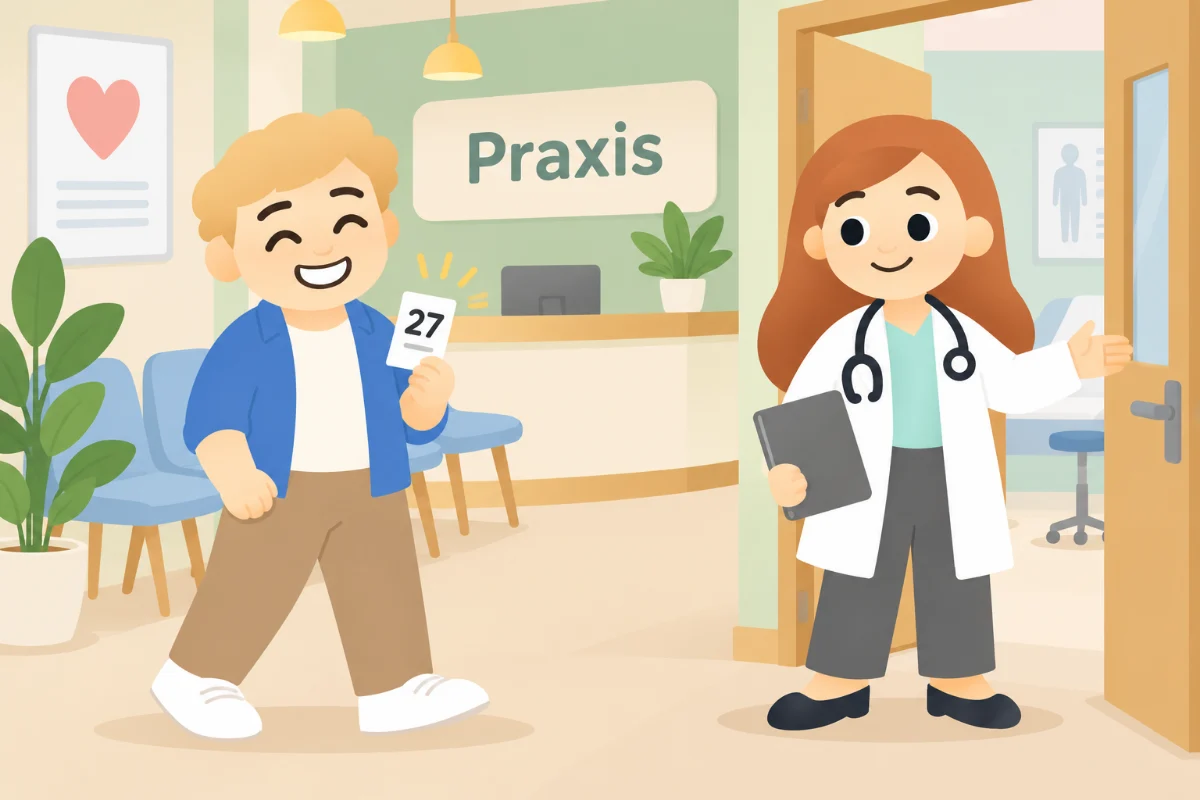
Tobias with a number ticket and Dr Weiß at the practice

To talk to your doctor in German, show your “Versichertenkarte” at reception and say “Ich habe einen Termin.” Describe your problem with “Ich habe seit … Tagen …” or “Mir tut … weh.” The doctor may give you a “Rezept” for medicine, an “Überweisung” to a specialist or a “Krankschreibung” for work.

At the reception

Go to the reception desk first. Staff will ask for your health insurance card and check your details.

Guten Tag, ich habe um zehn Uhr einen Termin.Hello, I have an appointment at ten.
Ich bin zum ersten Mal hier.This is my first time here.You may get a form to fill in.
Hier ist meine Versichertenkarte.Here is my health insurance card.Many people call it “Krankenkassenkarte”.
Ich bin privat versichert.I have private insurance.Staff may ask “Gesetzlich oder privat?”

Describing symptoms and pain

Say where it hurts, since when and how bad it is. Short sentences are enough.

Ich habe seit drei Tagen Halsschmerzen.I've had a sore throat for three days.Use “seit” for how long.
Mir tut der Rücken weh.My back hurts.For more than one place, say “Mir tun die Füße weh”.
Es tut hier weh.It hurts here.Point to the place.
Ich habe Fieber.I have a fever.
Mir ist schwindelig.I feel dizzy.
Die Schmerzen sind sehr stark.The pain is very bad.For mild pain, say “nicht so stark”.

Questions the doctor asks you

The doctor will ask a few standard questions. Knowing them helps you answer quickly.

Was fehlt Ihnen denn?What seems to be the problem?
Seit wann haben Sie die Beschwerden?How long have you had these symptoms?“Beschwerden” means symptoms or complaints.
Nehmen Sie regelmäßig Medikamente?Do you take any medication regularly?
Wie stark sind die Schmerzen auf einer Skala von eins bis zehn?How bad is the pain from one to ten?

Prescriptions and instructions

At the end, the doctor tells you what to do next. Ask again if anything is unclear.

Ich schreibe Ihnen ein Rezept.I'll write you a prescription.
Wie oft soll ich das nehmen?How often should I take it?
Zweimal täglich nach dem Essen.Twice a day after meals.
Ich überweise Sie an einen Facharzt.I'll refer you to a specialist.You get an “Überweisung” for the specialist.
Können Sie mich bitte krankschreiben?Could you give me a sick note, please?The sick note is a “Krankschreibung”.

At the pharmacy

You take your prescription to a pharmacy (“Apotheke”). You can also ask there for advice on small problems.

Ich möchte dieses Rezept einlösen.I'd like to fill this prescription.
Haben Sie etwas gegen Kopfschmerzen?Do you have something for a headache?

A short example with the doctor

You see Dr Weiß because you have a sore throat and a fever.

Dr Weiß
Guten Tag. Was fehlt Ihnen denn?Hello. What seems to be the problem?
You
Ich habe seit drei Tagen Halsschmerzen und Fieber.I've had a sore throat and a fever for three days.
Dr Weiß
Nehmen Sie im Moment Medikamente?Are you taking any medication at the moment?
You
Nur etwas gegen das Fieber.Only something for the fever.
Dr Weiß
Ich schreibe Ihnen ein Rezept. Eine Tablette morgens und abends.I'll write you a prescription. One tablet in the morning and one in the evening.
You
Können Sie mich bitte auch krankschreiben?Could you also give me a sick note, please?
Dr Weiß
Ja, bis Freitag. Gute Besserung!Yes, until Friday. Get well soon!
You
Vielen Dank. Auf Wiedersehen!Thank you. Goodbye!

How seeing a doctor works in Germany

Most people go to their “Hausarzt” first. This is a general doctor who knows your history. If you need a specialist (“Facharzt”), your Hausarzt can give you an “Überweisung”. Some specialists ask for one before they see you.

If you are too ill to work, the doctor can give you a “Krankschreibung”. Employers usually need one from your fourth day off sick. Some ask for it from the first day, so check your contract. You still need to tell your employer yourself that you are ill.

Prescription medicine comes from an “Apotheke”. Pharmacists can also help with small problems like a cold or a headache.

Tips for your appointment

In an emergency, call 112. For urgent problems when your practice is closed, call the medical on-call service on 116 117.

Before your visit, write down your symptoms and when they started. Bring a list of any medicine you take. If you do not understand an instruction, ask “Können Sie mir das bitte aufschreiben?”

Questions

How do I say I feel ill in German?

Say “Ich bin krank” or “Mir geht es nicht gut.” Then name your symptoms, such as “Ich habe Fieber.”

What is the difference between a Hausarzt and a Facharzt?

A Hausarzt is a general doctor and usually your first stop. A Facharzt is a specialist, such as a dermatologist. Your Hausarzt can refer you to one with an Überweisung.

How do I get a sick note in Germany?

See a doctor and ask “Können Sie mich bitte krankschreiben?” The doctor decides how many days you need. Tell your employer that you are ill on your first day.


Tags

At the doctorGerman phrasesHealthLife in Germany

Share this article

Try it when it opens

We will email you when it is ready.

Join the waitlist