Most medicines in Germany are sold only in an Apotheke. Show your prescription or health insurance card and say “Ich möchte ein Rezept einlösen.” Without a prescription, describe your problem and ask “Was können Sie empfehlen?” At night and on Sundays, a Notdienst-Apotheke is open near you.
Prescriptions
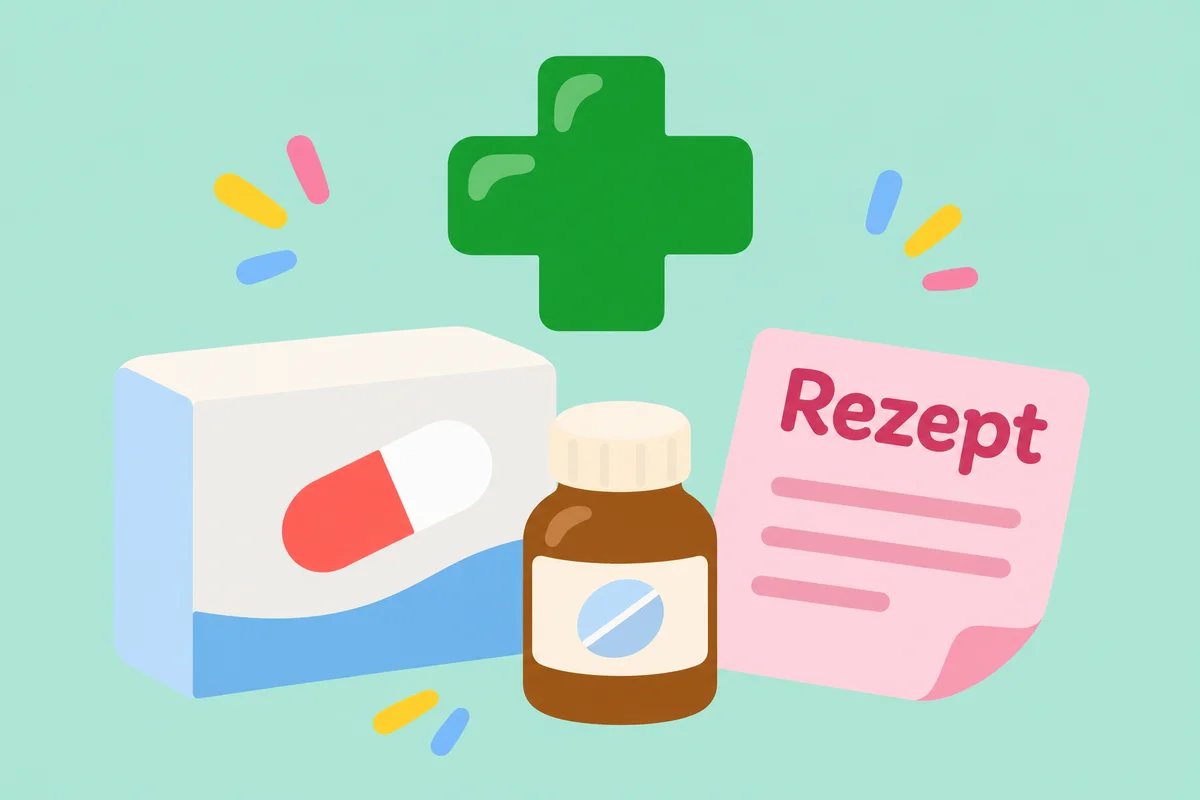
A prescription is a Rezept. Many prescriptions are now electronic and the pharmacy reads them from your health insurance card.
Without a prescription
Many medicines are rezeptfrei but still only sold in a pharmacy. The staff can advise you.
Describing symptoms
Keep it short. Say what is wrong and since when.
How to take it
Ask how often and when to take your medicine. Staff often write it on the box for you.
Apotheke or Drogerie
German law sorts medicines into three groups, and each group decides where you can buy it.
- Rezeptpflichtig. You need a prescription from a doctor. Only pharmacies sell these. The formal word is “verschreibungspflichtig”.
- Apothekenpflichtig. You do not need a prescription, but only pharmacies sell these. Most medicines are in this group.
- Freiverkäuflich. Mild remedies like herbal teas, throat lozenges and vitamins. You can buy them in a Drogerie such as dm or Rossmann, or in a supermarket.
Finding a Notdienst-Apotheke
At night, on Sundays and on public holidays, one pharmacy in your area stays open.
- Check the window. Every pharmacy shows the nearest Notdienst-Apotheken in its window.
- Search online. Enter your town or postcode on the aponet.de Notdienst search.
- Call. From a landline, call 0800 00 22833 for free. From a mobile, call 22833 without an area code. This costs up to 69 cents a minute.
- Expect a small fee. Between 8 pm and 6 am and on Sundays and public holidays, pharmacies may charge 2.50 euros extra.
How paying for medicine works
With public health insurance, you pay part of the cost of prescription medicine. This Zuzahlung is 10 percent of the price. It is at least 5 euros and at most 10 euros. You never pay more than the medicine costs. Children and teenagers under 18 pay nothing.
For an E-Rezept, your doctor stores the prescription digitally. Give your health insurance card to the pharmacy staff. They put it into a card reader and see your prescription. You do not need a PIN for this. You can also use the “Das E-Rezept” app or a printed code.
Pharmacists can help with small problems like a cold or a headache. If your symptoms are serious or do not get better, see a doctor. For urgent problems when your practice is closed, call 116 117. In an emergency, call 112.
Sources: gesund.bund.de: Arzneimittel mit und ohne Rezept, gesund.bund.de: E-prescriptions at a glance, Bundesgesundheitsministerium: Zuzahlung und Erstattung von Arzneimitteln, aponet.de: Notdienstsuche, aponet.de: Apotheken-Notdienst finden, Arzneimittelpreisverordnung § 6: Notdienst
Questions
What is the difference between an Apotheke and a Drogerie?
An Apotheke is a pharmacy with trained staff. It sells prescription medicine and most other medicines. A Drogerie like dm or Rossmann sells toiletries and only mild remedies like teas and vitamins.
How do I find a pharmacy that is open at night in Germany?
Look at the list in any pharmacy window. You can also search on aponet.de or call 0800 00 22833 for free from a landline. At night the pharmacy may charge 2.50 euros extra.
How do I say “I need something for a cold” in German?
Say “Ich brauche etwas gegen Erkältung.” Add your main symptom, for example “Ich habe Halsschmerzen.” Then ask “Was können Sie empfehlen?”