The Goethe-Institut estimates about 450 to 600 hours of lessons to reach B2. At B2 you can talk with Germans without much strain. At five to seven hours a week, that takes about 15 to 28 months. Extra practice outside lessons and living in Germany make it faster.
Hours by level
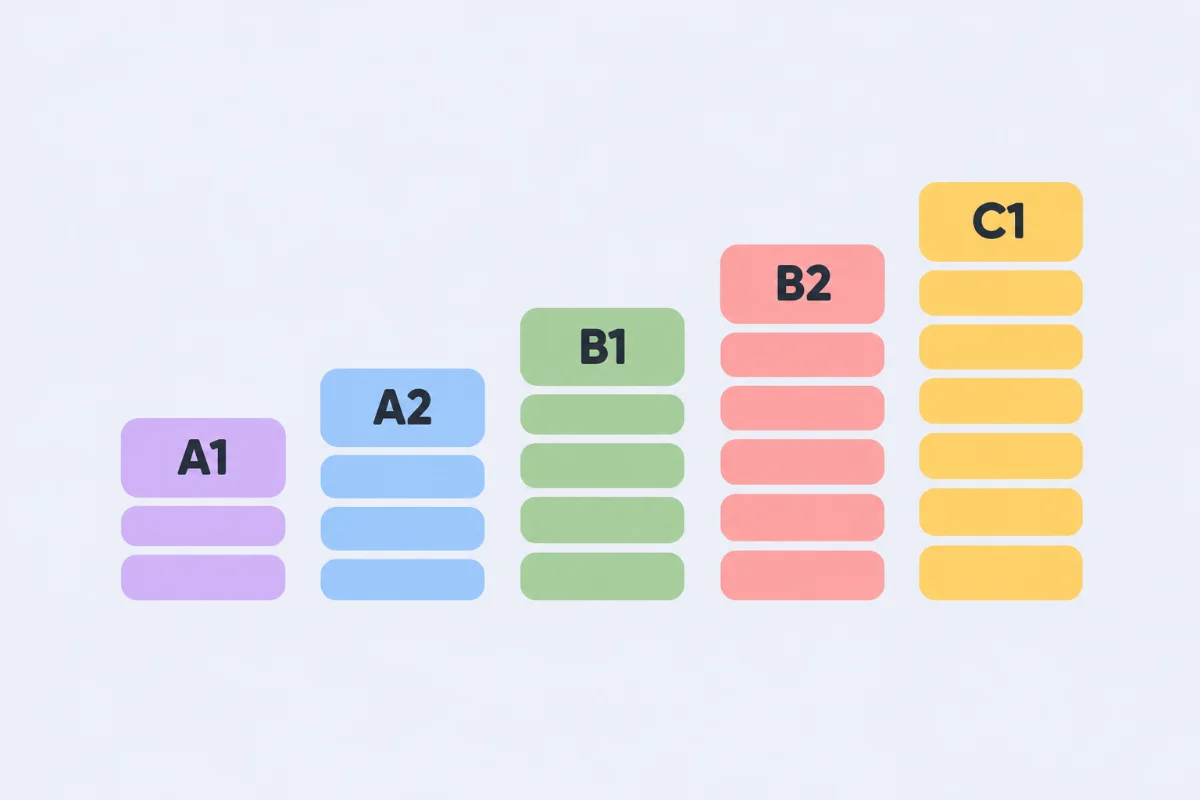
| Level | What you can do | Lessons of 45 minutes | Hours |
|---|---|---|---|
| A1 | Introduce yourself and use simple everyday phrases | 80 to 200 | about 60 to 150 |
| A2 | Handle routine tasks like shopping or asking the way | 200 to 350 | about 150 to 260 |
| B1 | Manage most everyday situations and talk about your plans | 350 to 650 | about 260 to 490 |
| B2 | Talk with native speakers without much strain | 600 to 800 | about 450 to 600 |
| C1 | Speak fluently and spontaneously at work or university | 800 to 1,000 | about 600 to 750 |
What B2 takes at different paces
These figures use the Goethe-Institut's estimate of 450 to 600 hours for B2. Your own practice comes on top.
- Full-time intensive course. With 20 hours of lessons a week, B2 takes about five to seven months.
- Evening course plus homework. With 10 hours a week, B2 takes about 11 to 14 months.
- Self-study around a full-time job. With 5 hours a week, B2 takes about 90 to 120 weeks. That is roughly two years.
What changes the speed
The Goethe-Institut ranges are wide. These things decide where you land.
- Time per week. Ten hours a week gets you there about twice as fast as five. Regular weeks count more than the odd long weekend.
- Practice outside lessons. The hour estimates count lessons only. Homework, reading and real conversations on top of them speed you up.
- Living in Germany. You hear German every day and need it for real tasks. The Goethe-Institut notes that learning in Germany helps.
- Languages you already know. If you have learned another language before, you already know how to study. Speakers of Dutch or Danish also find many familiar words.
- Speaking practice. Fluency is a speaking skill. You build it by speaking, so plan time for it every week.
What fluent means
Fluent means different things to different people. Most learners mean they can hold a normal conversation without stopping to search for words. In CEFR terms, that is somewhere between B2 and C1.
The CEFR says a B2 speaker can talk with native speakers “without strain for either party”. At C1 you express yourself “fluently and spontaneously without much obvious searching for expressions”.
Fluent does not mean perfect. Even at C1 you will make small mistakes and may keep an accent. People will still understand you easily.
Sources: Goethe-Institut London: Frequently asked questions about courses, Goethe-Institut Glasgow: Frequently asked questions about courses, Goethe-Institut: Goethe-Zertifikat A1, further information, Goethe-Institut: Goethe-Zertifikat B2, further information, Goethe-Institut Ungarn: Goethe-Zertifikat C1, weitere Informationen, Council of Europe: CEFR global scale, U.S. Department of State: Foreign Language Training (FSI), bpb: Integrationskurs
Questions
How long does it take to reach B1 German?
The Goethe-Institut estimates 350 to 650 lessons of 45 minutes, or about 260 to 490 hours. The language part of the German integration course aims for B1 and usually has 600 lessons.
Can I become fluent in German in one year?
With full-time study, B2 in a year is possible. The US Foreign Service Institute trains its staff full time for about 36 weeks to reach a professional working level. With a job and five to seven hours a week, expect to be around B1 after a year.
Is C1 the same as fluent?
C1 is fluent for most purposes. You speak spontaneously and can handle complex topics. Many people already feel fluent at B2.