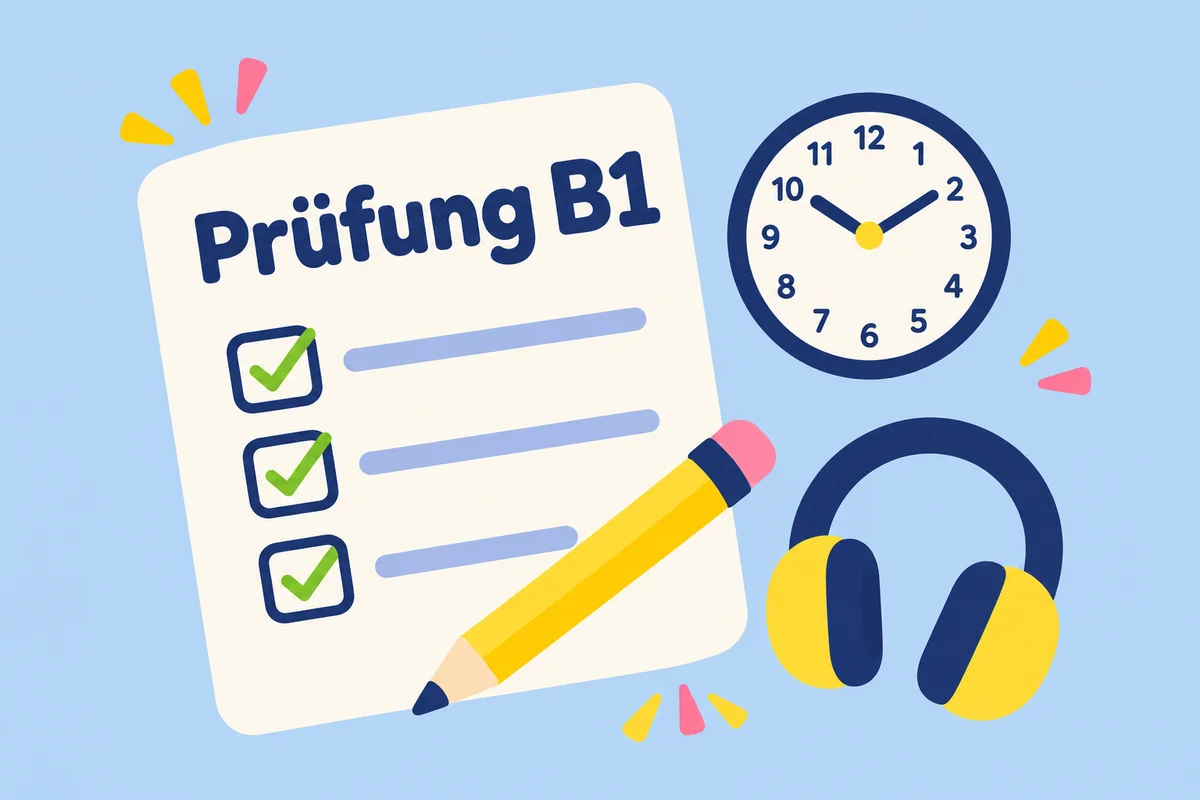
The Goethe, telc and DTZ exams all prove B1 German. Each one tests listening, reading, writing and speaking. The speaking test is usually in pairs. B1 is the level for German citizenship and the standard settlement permit. From 1 November 2026 a B1 result in the DTZ also needs at least A2 in the third part.
Giving your opinion
You need these phrases in the telc discussion and in the Goethe presentation. Give a reason for each opinion.
Planning something together
In the planning task you suggest, react and agree. Keep the conversation moving and include your partner.
Presenting a topic
The Goethe presentation follows the five slides. These phrases take you from the start to the end.
Feedback and questions
At the Goethe-Institut you react to your partner's talk. One sentence of feedback and one question are enough.
The three exams
All three exams test the same level. They differ in format, preparation time and how you pass.
- Goethe-Zertifikat B1. Reading takes 65 minutes, listening about 40, writing 60 and speaking about 15 for a pair. You can take the four modules alone or together and pass each one with 60 of 100 points.
- telc Deutsch B1. The written part takes 150 minutes for reading with grammar tasks, listening and one email. You need 60 percent in the written part and 60 percent in speaking.
- Deutsch-Test für Zuwanderer (DTZ). It is the final exam of the integration course and shows A2 or B1. The written part takes 100 minutes and speaking about 15.
Who needs which exam
Authorities ask for the level and accept several exams. These are the common cases.
- Citizenship. The Nationality Act asks for B1. Bavaria accepts Goethe, telc, ÖSD, the DTZ and the Deutsch-Test für den Beruf at B1, but Goethe only with all four modules.
- Settlement permit. The standard settlement permit asks for B1. EU Blue Card holders can apply after 27 months with A1 or after 21 months with B1.
- Integration course. The course ends with the DTZ. You get the “Zertifikat Integrationskurs” with B1 in the DTZ and a pass in the “Leben in Deutschland” test.
- Work. Your employer decides unless your job has a legal requirement. The job-related German courses run by the BAMF end with the Deutsch-Test für den Beruf.
The speaking test at the Goethe-Institut
You get 15 minutes to prepare alone. You may take notes into the exam, but you should speak freely.
- Part 1: Plan something together. You and your partner plan a task for about three minutes. You make suggestions, react to each other and agree on a plan.
- Part 2: Present a topic. You choose one of two topics and talk for about three minutes. Five slides guide you through the topic, your experience, your home country, pros and cons and an ending.
- Part 3: Talk about the topics. After your talk you answer feedback and questions from your partner and an examiner. After your partner's talk you say what you liked and ask one question.
The speaking test at telc
You get 20 minutes to prepare. You may use your notes, but you should not read them out.
- Part 1: Get to know each other. For about three minutes you talk with your partner about yourselves. Typical points are where you come from, your family, your work and your languages.
- Part 2: Talk about a topic. For about six minutes you each report a different opinion from a short text. Then you discuss the topic with your own views and experiences.
- Part 3: Plan something together. For about six minutes you organise an event like a party. You suggest ideas, react to your partner and agree who does what.
The speaking test in the DTZ
There is no preparation time. The test is usually in pairs. The examiners judge each task as below A2, A2 or B1.
- Part 1: Introduce yourself. You talk about yourself for about a minute with keywords like name, home town, work, family and languages. The examiner then asks one or more follow-up questions.
- Part 2: Talk about your experience. You each describe a photo and talk about your own experience for about three minutes. The examiner then asks about life in your home country and in Germany.
- Part 3: Plan something together. You and your partner plan something like a party with the neighbours for about six minutes. The examiners do not join in.
A practice round for the planning task
You practise a planning task with your friend Nadia, so you use du.
The DTZ change from 1 November 2026
The DTZ has three areas: “Hören/Lesen”, “Schreiben” and “Sprechen”. Until 31 October 2026 you get B1 overall with B1 in speaking and B1 in one of the two other areas. The third area has no minimum.
From 1 November 2026 the third area must reach at least A2. So you need B1 in “Sprechen” and B1 in “Hören/Lesen” or “Schreiben”. The remaining area needs A2 or better. The change comes from an amendment to the Integration Course Test Regulation of 13 October 2026.
If you take the DTZ soon, plan for all three areas. A weak result in writing can now cost you the B1 certificate. Ask your course provider which rule applies to your exam date.
Sources: Goethe-Institut: Goethe-Zertifikat B1, Durchführungsbestimmungen (1 September 2025), Goethe-Institut: Goethe-Zertifikat B1 Modellsatz Erwachsene, telc: Zertifikat Deutsch / telc Deutsch B1, telc: Zertifikat Deutsch B1 Übungstest 1, BAMF: Abschlussprüfung des Integrationskurses, BAMF: Deutsch-Test für Zuwanderer, Prüfungsziele und Testbeschreibung, Bundesgesetzblatt 2026 I Nr. 306: Verordnung zur Änderung der Integrationskurstestverordnung, Staatsangehörigkeitsgesetz § 10, Aufenthaltsgesetz § 9: Niederlassungserlaubnis, Aufenthaltsgesetz § 18c: Niederlassungserlaubnis für Fachkräfte, Stadt München: Positivliste von Sprachnachweisen (Bayern, Stand 27 June 2024), BAMF: Deutsch-Tests für den Beruf (DTB)
Questions
Which B1 exam is best for citizenship?
Goethe, telc and the DTZ can all count if they show B1. A Goethe certificate needs all four modules. A DTZ result counts only if it shows B1. Ask your naturalisation office if you are unsure.
Can I retake only the speaking part?
At the Goethe-Institut you can retake single modules. At telc you can retake the failed written or oral part in the same calendar year or the next one. For the DTZ, the BAMF allows one free retake under certain conditions.
How long is the B1 speaking test?
About 15 minutes for a pair in all three exams. You get 15 minutes to prepare at the Goethe-Institut and 20 minutes at telc. The DTZ has no preparation time.